Made in Manchester / Borrowed from New York
Includes Text from ‘The New York Dolls’ by Morrissey (1981)
Manchester & New York are very different cities but they have certain striking similarities: nineteenth-century architecture and infra-structure; a sea-trading history; urban decay on a grand scale; centuries of Irish immigration; a varied multi-cultural population; a reputation for music and club culture; and the English language.
Cultural traffic between the two cities has been largely one-way though. During my lifetime, like most Mancunians, I have consumed vast quantities of New York culture through TV, film and music, while Manchester’s main cultural export, football, is of little relevance to the lives of most New Yorkers.
Sesame Street, Starsky & Hutch, Hong Kong Fuey, Fame, Taxi, Rhoda, King Kong, Saturday Night Fever, Kramer vs Kramer, Tootsie, Ghostbusters, Andy Warhol, Blondie, Talking Heads, Patti Smith, Chic, Odyssey, Afrika Bambaataa, Public Enemy; layer upon layer of New York culture which I greedily consumed while I was growing up. Meanwhile my only windows onto my own city were Look North, Granada Reports and Piccadilly Radio.
I tried to like Coronation Street, I really did - not because it was local but because my friends at school talked about it incessantly. But I found it boring and depressing; even crushing teenage peer-pressure could not persuade me that Coronation Street was worth investing in emotionally. (We were all excited to discover that Dangermouse was produced locally but the cartoon’s content didn’t reflect this.)
And what else did we have? 10cc, Sad Cafe, Jilted John, The Buzzcocks… I didn’t know much about Joy Division until long after Ian Curtis died. It was the infamous story of his death and the subsequent success of Love Will Tear Us Apart which brought Joy Division and New Order to the attention of teenagers like me.
When The Smiths appeared, they seemed to be in a league of their own. Here was something sophisticated which was also unmistakeably homegrown, and appeared to revel in its localness. Morrissey’s verbal and visual language, which combined familiar mundane references with unlikely urbane artistic ones, had the effect of raising Manchester’s status in our eyes.
At the time I had no knowledge of Morrissey’s long-standing devotion to the New York Dolls; he was the self-appointed president of their UK fan club and wrote a short book about them, published by Babylon Books (Manchester) in 1981.
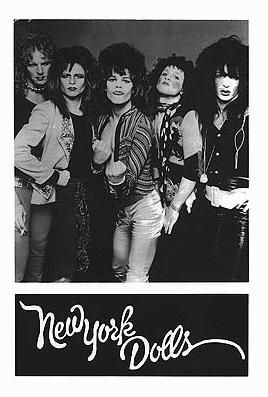
This came as a great surprise to me when I first heard about it. Much of The Smiths’ appeal in the 80s was their rejection of pop music stereotypes which UK music had been saddled with through our wholesale adoption of American pop culture - fake American accents, simplistic subject matter, the automatic assumption that all things American were cooler than anything from our local area.
We didn’t see Morrissey’s rockabilly look as particularly pro-American back in the 80s - it was an ‘anti-technology’ image - a visual message proclaiming ‘We don’t use synthesisers.’
I certainly never expected Morrissey to be devoted to a ’70s glam rock band which embodied everything about American rock excess which The Smiths self-consciously rejected.
This is what Morrissey wrote about the New York Dolls (1972-75) in 1981… (the book is out of print and very expensive to buy second-hand):
“The New York Dolls contract expired on the 8th of August, 1975. We had a two LP deal with them and it was decided at that time not to renew their contract. The reality is that neither of their LP’s sold very well. Not only that, but they were costing us huge amounts of because of their tendency to destroy hotel property. I truly believe that the company tried to be fair and patient with the Dolls but as talented as they were they were a continued source of aggravation for us”.
DONNA L. HALPER, East Coast A&R Director.
Phonogram, N.Y., October 7th, 1975.
The New York Dolls were the first real sign that the Sixties were over. Their unmatched vulgarity dichotomised feelings of extravagant devotion or vile detestation. It was impossible to look upon the Dolls as adequately midstream, just as it was impossible to ignore them. Enough was written about the group to fill a library. They were the ’cause celebre’ of New York’s avant garde. They served as a stark contrast to the tempo of the times with their “crude musicality”. They were transsexual junkies. They were downed out highschool toughs posing as bisexual psychopaths. They were this, they were that. Their music was unfaltering gall faced garbage. The music industry hated them. Their record company hated them. The Dolls’ teen slop would slip under after 3 years of moving a lot and getting nowhere. “We like to look bored to the bottom of our bowels,” claimed lead singer David Johansen, which, in 1973, was hardly ‘en regale’ as most people thronged in awe and religious homage to the synthetic energy of theatrical rock spawned lazily by David Bowie and Alice Cooper beneath the guise of creativity (that’s creativity with a capital £), and supported steadfastly by the mighty crutch of several merchant banks who gave birth to the bore of the decade, technology in rock. Rock music became an expensive business which thrived upon de-personalisation. It was controlled by corporates who had a knack of being oblivious to anything until it had been and gone. The New York Dolls could not possibly have been less attractive and how dare they! Those…semi-schizoid…mutli-sexual…doped-up denizens who announced:
“We’re saying something that Teen Earth is interested in.”
And it was true.
The Dolls became a derelict monument to devastated teenage America. New York’s last rock ‘clique’ housed The Lovin’ Spoonful and The Rascals, safe radicals who foresaw impending doom and switched off in protest. ‘What a day for a daydream’ could be heard only above the murmuring hum of lethargic meditation. The Velvet Underground peddled in uncharted territory, but their tepid frissons seemed positively prehistoric when the Dolls arrived.
Forming in 1972, the Dolls cancelled out all preceeding efforts at establishing New York City as a musical haven.
Lou Reed half-heartedly whinged ‘we’re coming out, out of our closets’ which served as a mild amusement to those already enthralled or appalled by David Bowie’s indeterminable gender. And it was all harmless fun, being eagerly adopted by a considerably larger number of groups and cherry red lipstick became as symbolic of the early ’70s as goatees and leather sandals to the late ’60s. But the New York Dolls, to many people, just weren’t very funny. Theirs was a sinister sense of transvestitism. ‘High camp’ for Roxy Music, ‘poovery’ for Marc Bolan, and even less for ‘lovable norms’ Slade and Sweet - such terms would never be accurate if aimed at the Dolls. The Dolls were just a little too real. It was a style beyond femininity; a gotesque collaboration of court shoes, bouffant hair, black lipstick, nail polish, exagerrated posturing …. and it all looked so perfect and natural. And suddenly Bowie’s pompadour posing dwindled into insignificance, Alice Copper’s fishnet tights were greeted with the laughter they deserved, and Roxy Music moved on to Hollywood gloss.
“Do you think I dress in absurd drag? Of course I do. I just reflect life.”
DAVID JOHANSEN
Sadly, the appearance of the Dolls would far too often overshadow their music. Wereas preceeding “realists” in rock music cerimoniously accepted Woodstock as their most accurate period piece, the Dolls abhorred the apathy of that generation. Instead, the Dolls offered audience interplay, humour in misfortune, and drew energy from desperation. The Dolls had been unemployable second-class citizens. They never had money, or even a proper job. By channelling all their energies into the group they were out to have fun, and make lots of money. They wanted as much as they could get and they wanted it NOW. But technically, the Dolls couldn’t really play very well.
“It doesn’t bother us when people say we can’t play. When we met we actually couldn’t” - JOHANSEN
To ‘stay loose and be crazy’ was the Dolls’ doctrine, and eventually, that they looked like haggard hookers from a 50′s B-movie became immaterial.
Nothing could detract from that music.
The Warhol-Morrissey “school” dominated the New York scene in the early ’70s. Their deliberately backward films such as ‘My Hustler’, ‘Trash’ and ‘Flesh’ spawned such beautiful and reactionary tragediennes as Holly Woodlawn, Jackie Curtis and the late Candy Darling. But such bohemian cavortings had their roots embedded in the Sixties and the self-celebratory I-Suffer-Therefore-I-Am Greenwich Village beautiful losers. The Dolls obliterated the very idea of such visionaries as those previously mentioned, and Lou Reed (who suddenly looked thirty). Something new developed, New groups, new songs, new ideas, new rock writers, new clubs, new rules (which were ‘No Rules’) and the Dolls set the place. Everything which pre-dated the Dolls at The Oscar Wilde Room became irrelevant. How strange - a group which actually spke for ‘now’, and even stranger still, their youth! The Stones hobbled under the weight of ‘Goat’s Head Soup’ and looked geriatric; Mott the Hoople, for one hysterical split-second were considered (by American audiences at least) a semi-drag ensemble, and they confessed, “don’t wanna be hip/but thanks for the great trip”. You see, beneath the pancake we have simple sons of the soil. Enter the New York Dolls.
Their beginning was unspectacular. David Johansen met Arthur Kane at a screening of ‘Beyond The Valley of the Dolls”. Arthur and compatriot Johnny Thunders were attempting to complete a group which Arthur himself had christened ‘New York Dolls’. The two had recruited Sylvain Sylvain and Billy Murcia from another group, and were on the look-out for a vocalist. There were smatterings of fleeting characters but David’s arrival legitimised the birth of the Dolls.
Johansen’s much celebrated participation in off-off-Broadway beef movies were brief. Of such endearing classics as ‘Studs On Main Street’ the failed goddess claims: “I was manipulated!” From then he performed half-heartedly in a few naive underground plays as well as becoming a dancer for an expanding theatre group ‘Fast Eddie & The Electric Japs’.
The Dolls, being quintessentially the definitive ‘pop/rock’ group, the type of which beating hearts and soiled undergarments are encouraged, could have no other possible introductory file other than that of which “fan” memorabilia mentality dotes upon.
DAVID JOHANSEN
real name: David Johansen
birthplace: West Brighton,Staten Island, NY.
birthdate: January 9th, 1954
function: Vocals, harmonica, gongs
background: Middle-class Catholic with two brothers and three sisters. His father an insurance salesman, mother a Dan Berrigan fan.
previous groups: The Vagabond Missionaries, Fast Eddie & The Electric Japs
personal points: Youthful Simone Signoret, ‘savoir faire’, self-elected Dolls spokesman.
observation: “The boys hate us but the girls love us. We make the boys…umm,…insecure…”
JOHNNY THUNDERS
real name: John Gonzales
birthplace: Queens, New York
birthdate: July 15th, 1954
function: Guitar
background: None
previous groups: Johnny & The Jaywalkers
personal points: Unabashed Italian with the largest supply of hair in rock history. Natural flair for perpetual collapsibility.
observation: “From the beginning we all had this idea that we were gonna make it. We were right.”
SYLVAIN SYLVAIN
real name: Sil Hizrahi
birthplace: Cairo, Egypt
birthdate: Febuary 14th, 1953
function: Guitar, piano
background: Spouts of degeneracy
previous group: Actress
personal points: Chimpy impishness, ‘cutesy’ Harpo Marx curls
observation: “We dig anyone who has enough guts to do something different.”
ARTHUR KANE
real name: Arthur Harold Kane Jnr.
birthplace: The Bronx, New York
birthdate: Febuary 3rd, 1951
function: Bass guitar
background: Suprisingly scholarly
previous groups: Various popular rehabilitation centres
personal points: “Arthur is the only living statue in rock ‘n’ roll.” - Johansen
observation: “I just play evah comes innah mah head.”
JERRY NOLAN
real name: Jerry Nolan
birthplace: Brooklyn, New York
birthdate: May 7th, 1951
function: The drums
background: Oklahoman
previous groups: Wayne County’s Queen Elizabeth, Suzi Quatro Group
personal points: Of Irish parentage. His mother would send him good luck telegrammes before each important Dolls show; his father an ex-career army man, wouldn’t.
observation: “We don’t give concerts, we throw parties.”
Cut and pasted from Tim Costello’s Website.
The text demonstrates Morrissey’s fascination with New York’s avant-garde, as well as touching on many themes which recurred over and over again in his later creative work. This sentence stands out in particular:
“…the Dolls offered audience interplay, humour in misfortune, and drew energy from desperation.”
Morrissey used his influence to reform The New York Dolls in 2004 through the Meltdown Festival at London’s South Bank, which must have given him great personal satisfaction, while also demonstrating the Power of The Curator.
In the following interview, Johnny Marr describes how the ideas of David Johansen and Patti Smith, both based in New York, played an important role in the formation and development of The Smiths:
Johnny Marr talks about meeting Morrissey - by Figfilm
The first time Morrissey and I met properly..
…when he invited me into the house and I went into his room, the very first thing we did was he said
‘Do you want to put a record on?’…
…And I went over to this shoebox with 45s in it and I pulled out ‘Paperboy’ by The Marvelettes and played the B-side… … and I almost felt like he was kind of testing out where I was coming from. I was impressed that he had all them Marvelettes’ singles.
So our very first point of contact, conveniently, was a Motown record… …our very first thing, spark, was The Marvelettes.
So we very very consciously wore our girl group 60s retro influences on our sleeve, and they all came through his and my knowledge of that scene - both came from the same point of contact and that was through David Johanson and Patti Smith interviews in the English music press. That’s where we found out about… that’s where I found out about Phil Spector… through Patti Smith’s interviews… and that’s where I found about Sandie Shaw ironically , through David Johansen’s interviews… Morrissey was the same.
Our idols dug the girl groups’ retro sound so we just went to the source, as we saw it.
There are many other examples of Manchester’s prime movers consciously adopting trends generated through New York’s pop culture:
It’s quite weird to discover that things which seemed to me to be very Mancunian, are actually just reflections of New York trends instead. Not that there’s anything wrong with diverse cultural influences… quite the reverse… it’s just that New York’s overwhelming influence on Manchester’s culture in the 1980s doesn’t really represent ‘diversity’; ‘dominance’ might be a better description.
For almost a century now, New York has been a giant ideas engine, amazing on-lookers with its prodigious creative output; making such a powerful impression that many of us feel like we’ve already lived there in a previous life.
In the cases of The Smiths, New Order and The Hacienda nightclub, aspects of New York culture were assimilated by Mancunians and Salfordians, and the results were enormously influential.
The people were local, but their inspiration and influences weren’t; in fact they had a cultural direct-line to New York. The Smiths, New Order and The Hacienda were branded as ‘Made in Manchester’ but more accurately they were made using ideas which were acquired through an avid interest in the pop culture of New York. Is this why so many of the bold claims which have been made for Manchester’s own pop culture now ring so hollow?
Manchester has been a cultural satellite of New York, and is now becoming physically more like it. Urban villages are an exciting development but what we really need is our own ‘ideas engine’*, not a real-life version of ‘Friends’.
Postscript January 2013
*We had an ideas engine once but it proved unsustainable: Hulme’s concrete jungle.
Bloxham’s urban villages seem bourgeois by comparison but who knows what the triple-dip recession may transform them into?
Just stumbled across this:
http://www.telegraph.co.uk/culture/music/8579557/Morrissey-on…-his-musical-heroes.html