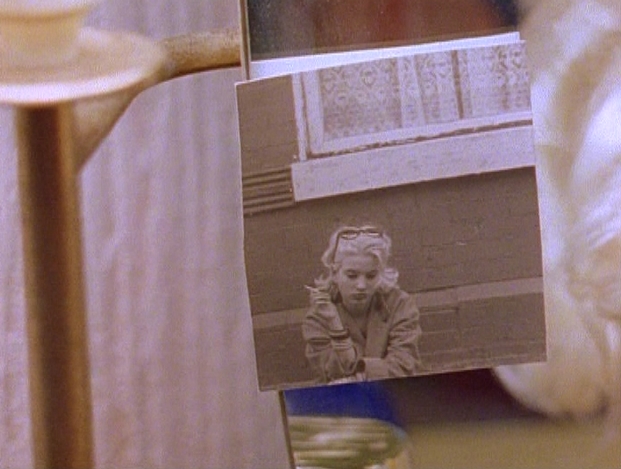
The Wild Child’s Revenge
Concerning ‘The Alcohol Years’, a film by Carol Morley (2000)
I enjoyed this film; thanks, Geraldine, for recommending it.
In her late mid-late teens, Carol Morley was remarkable for her nymphomania. This is the subject of her film and it is explored through the recollections of Carol’s old friends and acquaintances, who she tracked down and interviewed about 13 years later.
She had lost touch with them when she moved from Manchester to London, suddenly and without explanation, aged about 20 in June 1986.
The reasons behind Carol’s nymphomania are never explained… although her father’s suicide when she was a child is raised as a possible cause by some of her friends.
The film’s title is presumably meant to suggest another possible reason but this is totally unconvincing; I’ve known loads of alcohol-dependent people in my life and not one of them has been a nymphomaniac.
The title also cleverly suggests a line drawn under that period of Carol’s life, implying that her drinking and promiscuity came to an end in 1986.
In fact the only thing that altered in summer 1986 was Carol’s geographical location. It’s extremely unlikely that she stopped drinking and being promiscuous overnight. Either she picked up where she left off in London, or she ended up in rehab… or both.
The most amazing thing about Carol’s nymphomania is that there were apparently no major physical consequences: AIDS, Herpes, pregnancy, abortions – none of these things are acknowledged in the world described by her film – although they must, in fact, have been present in some form.
Carol’s film raises only one possible ‘bad consequence’ of her behaviour: premature death - that old rock’n’roll chestnut. Several interviewees mention this concern, but as we know this didn’t happen, we are left to believe that she sailed through unaffected.
* * * * * * * * * * * * * * * * * * * * * * * *
The title describes a span of time. We soon learn that this time in Carol’s life ‘equalled’ a particular place (Manchester) and a particular group of people, all quite distinct from her life since.
In this way, the film’s title and contents conspire to demonstrate that Carol’s behaviour was all about a particular time and place, which somehow absolves her of responsibility for her actions… and emphasizes the gulf between the old Carol and the new Carol.
The opening shot of the classified ad, via which Carol apparently searched for old friends and acquaintances, is a device intended to emphasize this gulf still further.
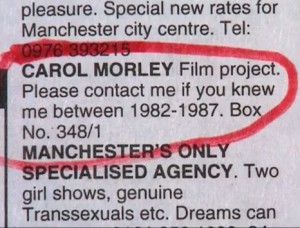
I am sure that Carol didn’t find her interviewees using the ad; most of those people hadn’t moved very far from where she last saw them… and most of them knew each another.
The interviewees recall that Carol was a striking teenager who liked attention; many recall her good looks, her unusual clothes and her props - the ‘toys’ she carried around with her – the duck on wheels and the train set. She was acting out a role… playing at being childlike… purposefully provoking interest in others, especially older men who worked in the music industry, which was no co-incidence.
If there were any justice in this world, one of those men would have written songs for her, mentored her successful music career, photographed her, promoted her or made a film about her… but very disappointingly for Carol, none of the above occurred.
In the end, she had to go out and make the damn film herself.
* * * * * * * * * * * * * * * * * * * * * * * *
I love the disarmingly simple construction of the film and the camera work in particular: the interviewees talking directly to camera; the shots of streets, houses and front doors opening to reveal people’s faces (and sometimes other things); the views of the city centre and the ‘flash-backs’ of wet pavements, rain-soaked steps, bedroom wallpaper and the inside of a greasy spoon cafe, all evoking young Carol’s visual memories.

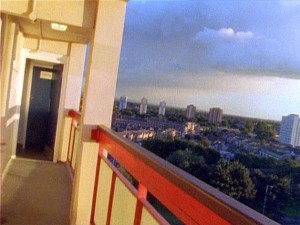
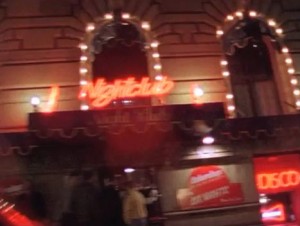
The Hulme flats were already gone when the film was made but Carol was able to film inside the derelict, vandalised Hacienda building, not long before it was knocked down, and the effect is wonderfully eerie.
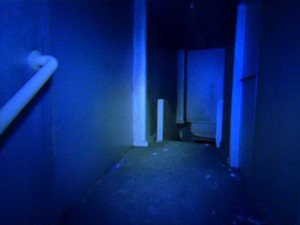


‘The Alcohol Years’ is a piece of alchemy through which an embarrassing failure is transformed into a successful work of art. Carol tried and failed to become a pop star in Manchester in the mid-80s. She left Manchester because her band TOT was dropped from The Tenth Event in June 1986. Ironically, the event was a damp squib… she needn’t have felt so crushed.
The film multi-tasks: it narrates the myth about Carol’s young self – the girl who should have been famous but wasn’t because people around her used and abused her and let her down.
It ensures that Carol Morley’s young self won’t be forgotten, so all that madness and self-destruction weren’t completely in vain: “yes she really was like that because all these people say she was.”
She punishes some of the people who let her down by opening them up to scrutiny.
And she distances herself from her past… by implying that her promiscuous behaviour was about a particular time and place and not something which was within herself.
* * * * * * * * * * * * * * * * * * * * * * * *
When Carol discusses ‘The Alcohol Years’ in interviews she comes across as the very opposite of the girl we hear described in her film; she is articulate, intellectual and apparently very respectable.
Anyone who watches the film, and then watches Carol being interviewed, will be struck by how much more sophisticated she appears than most of her interviewees.
Yes, Carol has moved on… to the capital… leaving behind the peasants where they belong, in their northern backwater, obsessing about the past… while by contrast, Carol is able to view that past objectively…
“I look at actuality and treat it creatively,” she says in interview.
‘Actuality’ my arse.
The film isn’t about actuality or objectivity although it pretends to be about both those things.
The film is a perfect piece of revenge… against the city which didn’t appreciate Carol… which didn’t make her a star, even though she was doing all the right things… all the things you’re supposed to do if you’re a young woman who wants to be famous.
She was sleeping with all the right men, apparently… although one of her interviewees calls her a ‘second-division star fucker’… perhaps that was because she was in Manchester. Perhaps you can only become a ‘premier division star fucker’ in London. Is that why she moved there?
* * * * * * * * * * * * * * * * * * * * * * * *
Carol Morley has every right to feel angry and disappointed about the way things worked out in Manchester. She was a determined, intelligent girl on a mission to be a pop star. She managed to get a band together, they wrote a couple of songs and they were signed to Factory Records, who failed to promote them. She was doing all the right things… and she knew all the right people.
Arguably, she should have spent less time getting wasted and sleeping around and more time writing songs, but that never did the Happy Mondays any harm, did it? (Well not at first.) Anyway she knew plenty of people who could have helped her out in the song-writing department. And pop stars are supposed to behave badly, aren’t they?
Carol Morley could give the Mondays and Oasis a run for their money in the bad behaviour department. She was perfect Manchester pop star material, but there was one huge problem: she was a girl.
Did she not realise? Did no-one explain to her? You can only be a pop star in Manchester if you’re a man. Nothing else will do. That’s the way it’s always been here, as long as anyone can remember. Maybe the penny dropped and that’s why Carol went to London.
* * * * * * * * * * * * * * * * * * * * * * * *
There’s going to be a Music Hall of Fame in Manchester. I can’t think of a single female face that will be in there… one that people will immediately recognise. I can’t think of many black faces either. Can you? What does that say about Manchester?
Hey!
Thanks for writing about The Alcohol Years… really interesting to read- I’m making a new film at the moment called Dreams of a Life that I’d love you to look at when the time comes.
All best with Mancky.
Carol x
Thanks for your comment, Carol. It’s brilliant to get real feedback from a real person…
The Alcohol Years has opened my eyes to just how bad attitudes towards women have been within the Manchester music scene over the years - I can’t imagine how I didn’t notice this earlier. It’ll be really interesting to see your next film,
Best wishes, Urs
“Boys town”! but check out http://en.wikipedia.org/wiki/Cath_Carroll
she was signed to factory.
x
I don’t recall Carol’s band, but have often wondered about Manchester’s “invisible girls” and why there is not one single female name to come out of the 1980s era. I remember a group called Glass Animals which may or may not have been something to do with Cath Carroll. I think Armed Force also had a female vocalist but in terms of people who were well known, I suppose there’s only Gillian from New Order and irrespective of whether she’s any good, she just happens to be the drummer’s missus. Was Manchester just a really sexist place then-what happened to all the girls?
Hi - I realised the same thing after watching Carol’s film and was really horrified:
http://www.mancky.co.uk/manchesters-female-pop-stars/
The gender imbalance in football is also depressing for local girls and women.
Writing for this site has considerably lowered my opinion of my home city’s local culture.