The Happy Mondays & The New Pecking Order 1988-1991
In 1988, the Hacienda queue draped around the curve of the building several nights a week… even when there was hardly anyone inside. The management used the punters as an advertisement for a club which was too cool to be identified by a normal sign.

Once inside, there was usually more queueing… for the cloakroom, the toilets (because there weren’t enough of them), and even the stairs when the place was full. And finally there was the queue for the cab home.
One night we were standing patiently on the corner, waiting for a taxi; I reached the front of the queue just as a black cab swung alongside the gap in the barriers. I stepped towards it, only to be knocked to the ground by a group of men, who barged past laughing and claimed it. My brother tried to challenge them but the door slammed and the cab drove off.
‘That was the Happy Mondays’, someone remarked as I was helped up off the floor. I was really shocked but the people around me weren’t; this was what they were like, apparently.
The Hacienda had always been a cool place, full of people trying to be stylish; it was pretentious but it was also quite civilised and innocent. Being arty and sensitive was ‘a good thing’ in that environment. There were lots of clothing designers, musicians, artists and art students milling around. But now it seemed the place was being colonised by people who swaggered about and took things by force. The Happy Mondays looked and acted like some of the people I went to school with, who had dropped out of my world when I went to sixth form and polytechnic, but now here they were again… knocking me over and nicking my cab.
I could have reported it to the Hacienda management, but the thought never crossed my mind. In those days, Factory bosses seemed very aloof. The company’s visual image spoke for them and the message was: “we are unapproachable, uncompromising and contrary; we are only interested in our own ideas.” There was a real ‘them and us’ attitude, or that’s how it seemed.

The enormous picture of Tony Wilson at the club entrance didn’t help; it made him seem like a larger-than-life smarmy svengali figure and his smile clashed weirdly with the receptionist’s attitude of total disdain. He and the New Order people drank in the Gay Traitor when they were in; I instinctively avoided them incase they mistook me for a groupie or a wannabe. Paul Mason and Paul Conns would stalk about looking tight-lipped and disapproving; their body language and expression said it all: “You paid to be here, but we are paid to be here.” It was obvious they viewed the punters as peasants. Leroy and Claire who managed the bars were friendly, but I only got to know them at Dry Bar later.
I had to grudgingly admit that the Happy Mondays’ music was good when I finally heard some of it. It sounded like a distant relation of Mark E Smith ranting at a house party.
Happy Mondays - Wrote For Luck
This was filmed at Legends on Princess Street, which is now 5th Avenue.
It was easy to avoid the Happy Mondays in the Hacienda, once I knew who they were, because they always hung out in the same alcove under the balcony. These little booths had seating round three sides, and the fourth side faced the dancefloor and stage; they were a major design flaw (or bonus, depending on your point of view) because they provided perfect hidey-holes for weed smokers and drug dealers.
During 1989, more and more Happy Mondays clones started coming to the club. Dry Bar opened in the summer and this balanced things out a bit by providing a social hub on Oldham Street, where many of the old regulars worked (in Afflecks Palace, Tibb Street and the clothing companies around Dale Street; the area wasn’t called the Northern Quarter then.) But by 1990, busloads of ravers were arriving from the sticks and the Hacienda was filled with shellsuits and whistles. I stopped going regularly… mainly because the door-prices rose, but also because of all the unfamiliar faces and the air of menace that took over the place.
The inside of the club resembled a weird sporting convention (because of the clothes) or a scene from Quatermass, where the nation’s youth gather in a brainwashed trance to be harvested by aliens. I remember my friends speculating that the Factory bosses might be harnessing the energy of the club’s occupants… perhaps in an attempt to gain eternal youth, or some other mystical goal. We didn’t realise that they were gradually losing control of the place.
On a rare trip back in August 1991 I was surprised to meet someone I was at school with working on the door. He let me and my friends in free because of the old school connection. The Happy Mondays had reminded me of people from my old school… and now some of those very people were running the Hacienda door; they controlled the dealers inside the club and took the lion’s share of the revenue generated. The Hacienda had become a machine for selling drugs and Factory had been out-manoeuvred, although they didn’t seem to grasp this at the time.
Why Factory management fought so hard to keep the Hacienda juggernaut on the road when they were no longer driving it remains a mystery. Perhaps it was a weirdly logical extension of their punk/anarchist manifesto… or perhaps they were just really naive. If they hadn’t got into bed with the gangsters* maybe the Hacienda building would still be standing.
I only went back to the Hacienda once after this, for a Flesh night in 1992.
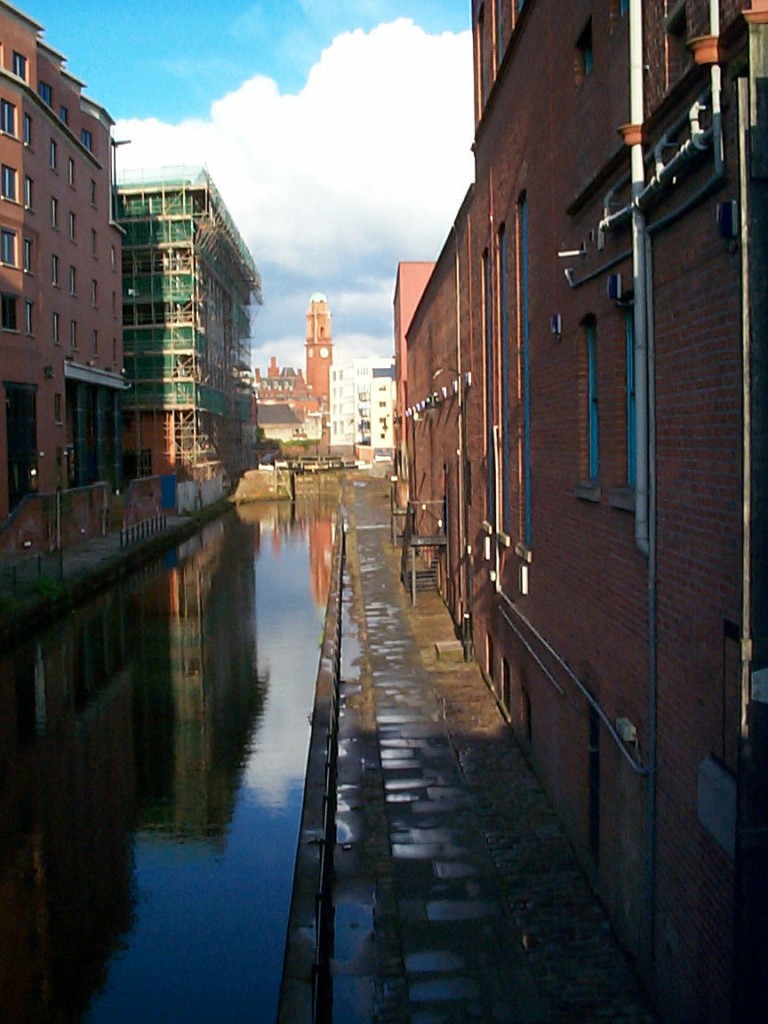
This is the view of the back of the Hacienda (on the right) taken in summer 1999 (on the same day I took the photo at the beginning of the post.) The Refuge Assurance tower on Oxford Road is in the distance, now the Palace Hotel.
The metal plaques on the Hacienda Apartments state that the Hacienda building was demolished in 1998 but in fact it was still standing in mid-1999, and although the warehouse/dancefloor area was demolished soon after these photos were taken, the curved ‘rotunda’ was still standing many months later.
I wonder why Crosby Homes chose to record this information incorrectly? Were they trying to conceal the fact that they were the ones who knocked it down?
*How Not To Run A Club, Peter Hook, page 215-17.
Your memory is pretty similar to mine. The club went from being a safe-haven (similar to places like The Venue, DeVills/Lazy Lil’s etc) for ‘sensitive types’ to increasingly becoming somewhere for the thugs and bullies to hang out. The Hangout at Isadora’s took over for us. Then we grew up and stopped going out
Hi Bob,
Isadora’s The Hangout has an FB group… you probably already found it…
https://www.facebook.com/#!/groups/42842303639/
Thanks for your message,
Best wishes, Urs