Hulme Concrete Jungle - 1972ish - 1992ish
When I was growing up, I travelled through Hulme to get into town; all I knew about the area was what I could see from the top deck of the 85 bus.
From this vantage point, the tree-lined roads of Whalley Range gave way to a sliver of Moss Side (seventies brick Alexandra Park Estate) before the bus crossed Moss Lane and approached the vast concrete structures of M15. The view was then resolutely grey and depressing all along Chichester Road/Greenheys Lane, Old Birley Street, Bonsall Street and Boundary Lane, until the bus turned onto Booth Street (all the Bs) towards the red brick and pale brown stone buildings of Oxford Road.
I went to secondary school with kids from Hulme (1977-1982) but I knew very little about their lives; they didn’t brag about their area, they only bragged when they were moving out. Even though the Hulme flats were still very new at that time, they were already a source of shame for the families that lived there.
 Charles Barry Crescent 1973
Then in the mid-eighties, for the first time, I met people who actually liked Hulme. Most came from outside Manchester city… to study, escape from their families or because they were bored by the confines of their hometowns. Hulme was almost a child-free zone by then, the families having been rehoused elsewhere, and residents were young adults who chose to live there - often rent-free. Many squats weren’t neglected as I had imagined; they were secure and kept in good condition. Keys were passed from person to person informally or sold on when a person moved out.
On the minus side there were cockroaches, pissy stairwells, no decent shops and the constant fear of meeting a nutter on a walkway. But the plusses out-weighed the indignities and risks for many; rent-free living close to the city centre was a big draw for students and creative people who were able to access a reasonable quality of life without needing a regular job or car. The usual economic certainties didn’t apply in Hulme and thousands of bohemian lifestyles and creative projects were spawned there as a result.
The Hulme concrete jungle was split into two distinct areas architecturally: the crescents and the decks.
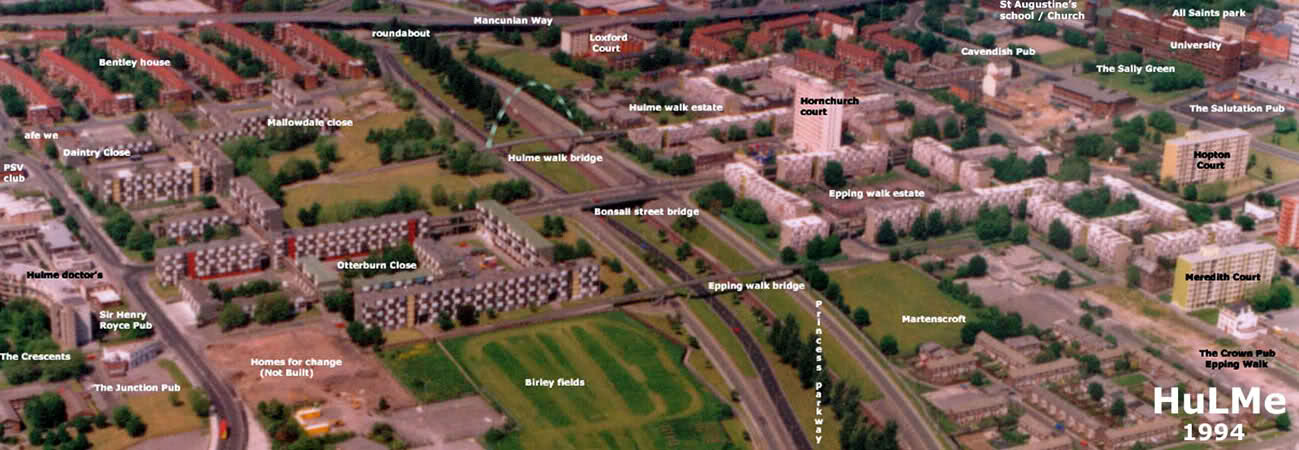
The decks were closest to Oxford Road and were built in a grid pattern around central courtyards. They lay on either side of Princess Parkway, between Royce Road and Boundary Lane. Hulme 3 was the ‘zone’ between Princess Parkway and Boundary Lane, while Hulme 4 lay between Princess Parkway and Royce Road.
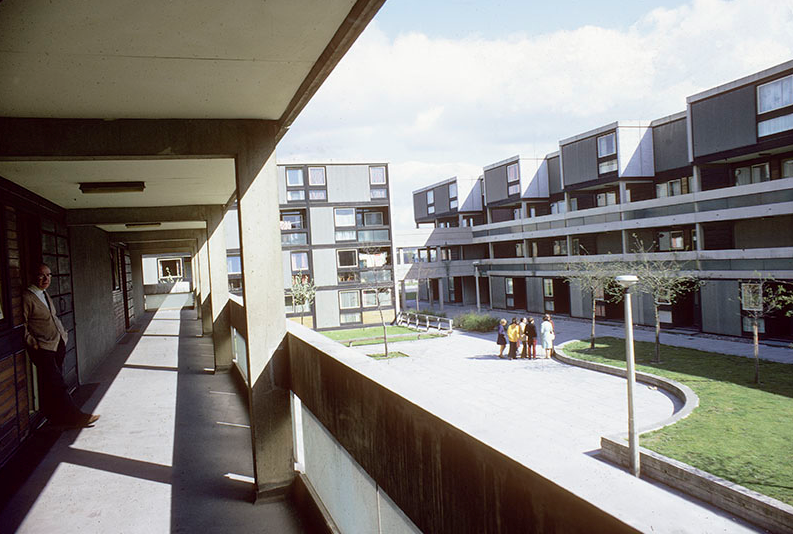 Elmin Walk 1973
The decks were generally no more than six storeys high, sometimes only four, and they were linked by walkways and footbridges which crossed the major roads. Most people preferred to cross the major roads on foot at ground level except for Princess Parkway which then, as now, was not intended to be approached by pedestrians and had to be crossed using footbridges.
The crescents were further away from Oxford Road and were therefore less attractive to students and people intending to walk back from town at night. They lay between Royce Road and Chorlton Road and their scale was intimidating as can be seen from this aerial photograph:

The crescents’ area was designated ‘Hulme 5′. Like the decks, the crescents contained 2 storey flats linked by shared walkways, but the structures were atleast eight storeys high and dwarfed the green spaces and few older buildings which still stood among them.
The Zion Centre was one of these buildings; it had previously stood on Stretford Road, but this part of the road was closed to traffic when the crescents were built, leaving the Zion Centre marooned and only accessible on foot. This would have been OK if people had felt happy walking around that part of Manchester but they didn’t. That stretch of road has now been opened again to traffic.
The four crescent-shaped structures were called Robert Adam Crescent, Charles Barry Crescent, William Kent Crescent and John Nash Crescent, together with Hawksmoor Close, which was a small straight block attached to Charles Barry Crescent. All these imposing buildings were named after outstanding British architects of the Enlightenment: John Nash (1752-1835) designed Regency London; Charles Barry (1795-1860) designed the rebuilding of the Houses of Parliament; William Kent (1655-1748) was famous for the Palladian Style, in particular the Treasury buildings at Whitehall; Robert Adam (1728-1792) was famous for the Neo-Classical Style and Nicholas Hawksmoor (1661-1736) was famous for his Baroque style architecture, in particular his six London churches.
This just goes to show the enormous confidence of the architects Hugh Wilson and J. Lewis Womersley; they were referencing giants of British architecture with the names of their new buildings. I don’t think this was ever explained to the people who lived in them though. Of course, some knew or found out, but that took patience and effort in the days before the internet, so many Hulme residents walked round in total ignorance of those names’ significance.
Hugh Wilson oversaw the design of Cumbernauld, the new town in Scotland where the tax offices are, before he undertook work in Manchester; Cumbernauld has been described as ‘a soulless concrete carbuncle surrounded by roundabouts.’ (It is the setting of the eighties film ‘Gregory’s Girl’.)
J. Lewis Womersley was the Chief Architect for the City of Sheffield in the 1950s. He oversaw the building of the infamous Park Hill Flats which replaced the Park Hill slums with ‘streets in the sky’. Park Hill still stands; now a listed building, it’s being redeveloped by Urban Splash under the supervision of English Heritage.
Wilson and Womersley designed the Student Precinct Centre and Business School on Booth Street, the Arndale Centre in Manchester city centre as well as the decks and the crescents in Hulme so they were clearly well in with the decision makers at Manchester City Council! There was an urban myth circulating in the eighties that one of the architects of the crescents was so distressed by his legacy that he hanged himself. There doesn’t seem to be any truth in this story however as J. Lewis Womersley died in 1990, aged 80, and Hugh Wilson died in 1985, aged 72, apparently of natural causes… unless it was one of their assistants.
Most of the flats I visited in the late 80s and very early 90s were in the decks as far as I remember. They were always very clean especially in the kitchen area; all food had to be kept in plastic boxes because of the cockroaches. Everyone had sticky cockroach traps which were constantly filling up with new victims.
The only crescents flats which I clearly remember visiting were the ones knocked through to create The Kitchen ‘club’; I would never have been able to find it on my own and I can’t remember which crescent it was in; it was on an upper level. Some people thought the Kitchen was great but when I went there (in late 1990) it was full of men who were either gauching or too pissed to form a sentence… so I didn’t hurry back there; it certainly wasn’t a rave.
Hulme’s grimey bulk was very glamourous in its own way: the concrete structures provided a gritty urban backdrop for the imaginary pop videos running inside the heads of the wannabe pop-star residents - certainly more rock’n'roll than Chorlton or Longsight.
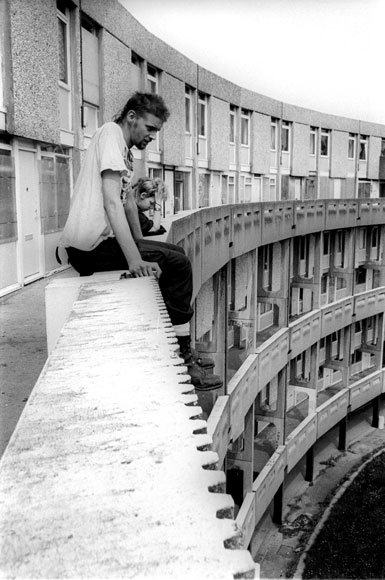 Thanks to Ian Robinson, www.starfishprime.co.uk, for this picture.
Teenagers from nice homes in the suburbs could move to Hulme and instantly feel genuinely angst-ridden just by walking over a footbridge. Some people enjoyed the frisson of danger generated by the initimidating architectural scale, the urban decay and the unpredictable behaviour of some of the inhabitants. Meanwhile others just put up with these inconveniences in order to live cheaply near town.
I remember giving a lift into Chorlton to a friend who lived in Hulme; Hughie stepped out of the car, surveyed the 1930′s semi-detached houses with rose bushes in the front gardens and uttered the word ‘surburbia’ in a derisive tone… yes it was easy to feel streetwise and gritty coming from Hulme - it might even give a person a superiority complex!
It was common knowledge that the emergency medical services wouldn’t attend the crescents at night. I would love to know what the working practices were with regard to public safety in Hulme. People weren’t paying rent or council tax, so they couldn’t demand the same level of service as everyone else, but as far as I know the bins were collected, and gas, electricity and water supplies were maintained.
There was an accidental gas explosion which killed a woman near Otterburn Close, some time in 1990. This caused wide-spread alarm amongst the residents of the decks nearby, as it brought home the real risks of living without guarantees of safety in the semi-anarchic adult playground which Hulme had, by then, become.
On a lighter note, I remember Hulme residents who were art students using their front room windows as ‘shop windows’ for their ideas, very much in anticipation of the modern facebook homepage habit of representing yourself to others using images or literary references.
My friend Angela and I were once making our way through the decks. As we descended into a stairwell we saw a hand of playing cards flung onto the floor face-up - it was a good hand (a running flush?) depending on which game the player was playing when he or she dropped it! My friend said ‘How very Hughie!’ referring to our friend who was into ‘situationism’; it was quite likely that the cards had been left there on purpose as an ephemeral art work, or maybe even a message!
I believe Hughie is now back in his home town of Blackburn - Hughie please get in touch if you should ever read this! (What was the name of the painting my mum bought from you? We can’t remember.)
For more fascinating pictures of Hulme, visit MMU resources at Flickr here: 72157625038079675/>mmuvisualresources.
For more historical background see www.manchesterhistory.net.
For stories and social history see www.exhulme.co.uk/.
Also this documentary made in 1978:
I found ur site on AOL and read couple of ur other entires. cool Stuff. I’m looking forward to reading more from you.
Pingback: johnprudence2013
Love the blog, the pictures - I’m becoming obsessed with Hulme 5.
Brought up in hulme also went to birley 77-82. There was a great community spirit until the family’s moved out. Good tomes
I lived in on of the crescents in 1976-77. Then my family took over the Spinners pub
nostalgic….i lived in the deck as student in early 90s…..by then hulme was almost deserted….n walking about at night was almost a no go area….