Bowie Boys & Pips Nightclub - 1980-82
Concerning ‘Manchester Slingback’ by Nicholas Blincoe (1998) and Pips Night Club
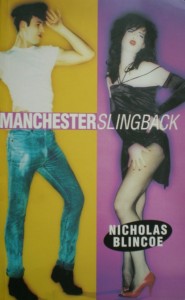
Manchester Slingback is about a group of gay and bisexual boys sharing a flat in the Hulme crescents circa 1981-82. Their lifestyles make entertaining subject matter - their worst betrayals are innocent by comparison with the exploits of the ‘real grown-ups’ they encounter, some of whom are involved in organised institutional child abuse.
Unfortunately, the story is clumsily packaged as a crime thriller through the addition of alternate chapters, set fifteen years later, which are dull and contrived.
One character - Jake - is always present. His defining quirk is his preference for Iggy Pop over David Bowie, which is odd because he was supposed to be a ‘Bowie Boy’. His desire to emulate Iggy apparently triggers his worst errors and excesses.
Although the boys spend much of their time in the Gay Village, they all seem to frequent Pips, behind the cathedral, which wasn’t a gay club. Manchester Slingback describes the complicated overlap between gay and straight club culture at a time when androgynous fashion was normal.
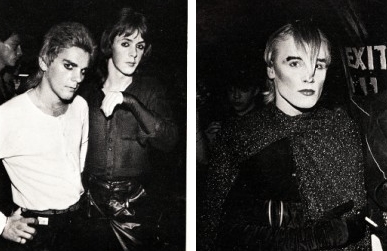
Photos by Kevin Cummins published in The Face December 1980 provide a glimpse of Manchester Slingback’s milieu:

David Roles, Nick Greenwood, Paul McVeigh - Manchester Bowie & Numan fans photographed by Kevin Cummins - The Face December 1980
At Pips Nightclub - by Kevin Cummins - The Face December M1980
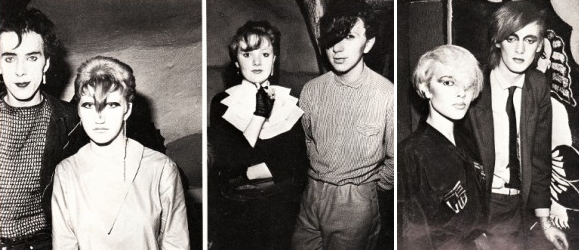
At Pips Nightclub - by Kevin Cummins - The Face December 1980
For me, the highlight of the book is Chapter Twelve, with its fly-on-the-wall account of a night out at Pips nightclub, circa 1981. I never went there but this description sounds very convincing:
“There were five dance-floors in Pips, each with a different theme and not all of them dedicated to gothics, romantics, queer boys, glamour pusses, starlets, cross-dressers, or whatever Jake’s group looked like that week. In descending order, there was the Roxy Room, the Bowie Room, the Electro Room, the Perry room, and finally, Floor Five, the only room without a name and without its own regulars…”
“He met Domino on the stairs to the Perry Room. The first thing Domino asked was whether he’d seen Sean… ‘He’s turned into a Perry; got the Lacoste sweater, the jumbo cords, everything.’
‘Really?’
…Jake squinted against the lights… Then he saw him, stepping around to the Gap Band in the weird Perry dance…a kind of forward/backward strut.”
“Each of the separate dance-floors was set into a grotto, their walls painted in coarse white stucco. The Bowie Room was decorated with different portraits of Bowie wobbling unevenly across the Polytex surface. The Roxy Room had similar pictures of Bryan Ferry, as well as one enormous painting of Lou Reed taken from the back cover of the Transformer album…”

Lou Reed - 'Transformer' (1972) Back Cover
“…Unlike the Bowie Room, there was less of a hard connection between the Roxy Room and its given name. Jake passed through a low arch and, for a moment, two different songs blended together … Bowie singing ‘Golden Years’ and, beneath it, the bass-heavy hum of a darker track… ‘Warm Leatherette’ by Grace Jones slowly segueing into ‘Homo Sapiens’ by Pete Shelley. Out in the rough circle of the dance-floor, Kevin Donnelly was dancing on his own… wearing a tight plastic T-shirt and Clash pants, both of them cast-offs from Johnny’s clothes pile.
…Kevin Donnelly turned to smile at him, the boy was wearing blue eyeshadow, a slash of disco glitter across his cheeks and an artificial beauty spot high on his cheek. The style was white disco-trash, Debbie Harry reborn as a boy. Jake winked and then tried to refocus, concentrating on finding the beat.”
Lots of New York references: Lou Reed, Debbie Harry, Iggy Pop. At exactly this time, Factory Records people were shuttling back and forth between Manchester and New York, researching their Hacienda nightclub project, which would represent a very different version of New York culture, and a club environment at the opposite end of the spectrum from Pips.
This photo montage by the BBC arts programme Omnibus was filmed in Pips Roxy Room in April 1977. It predates Manchester Slingback’s era by several years, but still seems a good fit with Kevin Cummins’ pictures of December 1980.
Pips was situated in the basement of The Triangle/The Corn Exchange just off Corporation Street (continuation of Cross Street.) The club was later called Konspiracy. This photo by Andy Allen shows the club entrance in the ’90s:
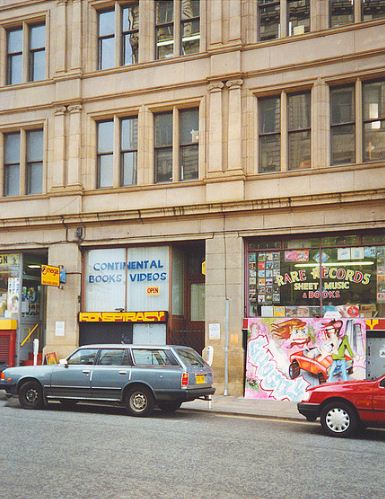
Konspiracy, Fennel Street - Andy Allen
Nicholas Blincoe solves one puzzle: the Perry Boys at Pips were Soul Boys, not Northern Soul Boys, although their ‘steppy’ dance sounds Northern Soul inspired. Definitions of what exactly constitutes Northern Soul can be contentious, but Blincoe’s Perrys danced to Earth, Wind & Fire and The Gap Band which is ’70s and ’80s soul/disco. But then maybe a room full of white people dancing exclusively to American black music is the true definition of ‘Northern Soul’.
Mick Middlehurst’s article accompanying Kevin Cummins’ photos from The Face December 1980 raises another puzzle though… why did the Bowie Boys (& Girls) of Manchester never produce a band?
“…Manchester has a ready-made audience impatiently waiting to latch on to a band, who represent the Pips set. I’m amazed it hasn’t happened yet.”
It would seem that, like Manchester’s Perrys, the Bowie Boys & Girls were content just to dress up; making their own music was somehow a step too far.
There were a few musicians hanging out at pips one being Martin Coogan the band were Vibrant Thigh who went on to become the Mock Turtles I used to sit through quite a few rehearsals around 1980
Thanks for that information… it did seem very unlikely that no-one came out of this scene… I wondered about The Smiths, but then wasn’t bold enough to make that claim.
Just read that A Certain Ratio formed through Pips Nightclub: http://www.pennyblackmusic.co.uk/MagSitePages/Article.aspx?id=4963
Hi, just read the books description of Pips and can assure you it was nothing like that. At the time the book was set, there was the Roxy Room which was, indeed, a grotto style room. I was deejaying there at the time and the music was across the alternative spectrum from Bowie/Roxy/Reed to electro (Human League/The Normal/DAF etc) to the pioneers of Goth (Bauhaus/Siouxsie) to pioneering dance like Grandmaster Flash and not forgetting Killing Joke. Then there was the Roxy overflow room in the basement to cope with the fact that the alternative kids made up the bulk of the clientele, a “pop” room and on the top floor, what I can only describe as a Stag/Hen party room playing the most horrendous music imaginable!
As for the Perry boys, many of them were actually into the alternative scene which was, at times, a bit hairy because they would come and dance to a few tunes then kick off with the alternative kids. The manager at the time was a nice bloke but wasn’t strong enough to control the violence that the Perry boys brought to the club and combined with the owners unwillingness to invest in the tired premises when places like Legend were opening, these factors did, I believe, bring about the closure of Pips as was.
As for bands, I remember ACR, Joy Division, Morrisey, Slaughter & the Dogs all being punters at one time or another. Perhaps the statement that the Pips kids never had a band to represent them is perhaps more a testament to how diverse they were as a crowd.
Thanks very much for all this information Alan. The story of Pips’ demise sounds very familiar. I’ll hopefully come along to the 30th Anniversary Event in June although I’ll feel like a fraud because I never went there originally.
Hi Alan, remeber the 2 Brothers , Steve and Mark ”Adge”.
Didnt they have some band going called Pressure ?
I#m sure I saw them playing somewhere ( could have been Pips ? ).
I use to go! ex- smiths.
hi when when is next re/ union please ? .. paul
Hi Paul
It’s on May 26th 2013
The info about the group is on Facebook:
https://www.facebook.com/#!/groups/Pips.Disco/
Urs
Pips was so much cooler and earlier than the Blitz London Scene and inspired Manchester’s musical scene for a generation -
I was part of it - and it will always remain part of me.
Chris Roche Architect (Roxy Fan)